Building Hope in Housing: Why Housing Has Become So Difficult
For most people, housing is pretty simple. You need somewhere to live. You want it to be safe, comfortable and reasonably affordable. You would like it to be in a community where you can work, raise a family, see friends and build a life.
The problem is that getting enough of those homes built has become anything but simple.
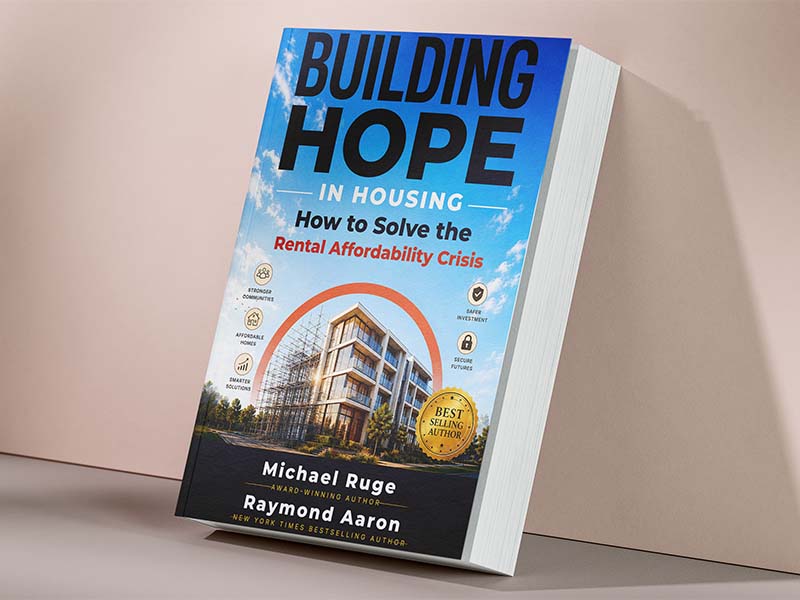
That is the starting point for Michael Ruge’s new book, *Building Hope in Housing: How to Solve the Rental Affordability Crisis*. Written with New York Times Best Selling Author Raymond Aaron, and featuring a foreword by Loral Langemeier, author of *The Millionaire Maker*, the book takes readers inside the housing system and asks why something as fundamental as providing people with a place to live has become so complicated.
Michael Ruge brings a particularly useful perspective to the conversation. As an award-winning author and experienced real estate developer, he has spent years dealing with the realities of development rather than simply observing the housing market from the outside.
That comes through in the way he writes about the problem. This is not a book that spends all its time pointing fingers. It is a book about understanding what is happening and figuring out where the system can work better.
 The problem is certainly serious. Young people under 40 are increasingly saying that they have given up hope of ever owning a home. That is a striking statement because it reflects something much deeper than affordability. It reflects a loss of confidence that home ownership is still achievable.
For those who cannot buy, renting should provide a realistic alternative. Yet rental affordability is also under pressure. When housing supply does not keep pace with demand, rents rise, and people are forced to spend more of their income simply keeping a roof over their heads.
So how did we get here?
Michael begins by looking at the housing crisis as something society has built over time. There are many contributing factors, and they all interact. Housing supply has not kept pace with demand. Construction has become more expensive. Financing is more difficult. Development approvals can take years. Regulations can become complicated. Every additional cost and delay affects the final economics of a project.
The important point is that none of this is inevitable.
That is the optimism running through the book.
If we understand how the system works, we can begin to change it.
One of the first areas Michael examines is financing. From the outside, it can seem strange that a bank would say no to a project when a community clearly needs the housing it would create. The reality is that banks have to manage risk. They tend to favour predictable projects with stable cash flow and clear security.
Development is different. There can be a long period when money is going out and very little is coming in. A developer may have secured the land and developed a strong project, yet still face years of approvals before construction can begin.
This is where private lending can become important.
Michael’s discussion of private capital is written from the perspective of the investor. These are people who have worked hard to build savings and now want their money to produce a return. Instead of leaving all of their capital exposed to public markets, private lending can provide an opportunity to invest in real estate projects with security connected to tangible assets.
There is an appealing simplicity to that model. Capital goes to a project. The project creates something real. The developer gets the financing required to move forward, and the investor earns a return according to the agreed terms.
Of course, not every project is a good project, and not every developer is capable of delivering. Experience, due diligence and proper security still matter. Michael’s point is that private capital can play a meaningful role in filling a financing gap that traditional lenders cannot always fill.
Then there is the approval process.
This may be one of the most relatable parts of the book for anyone who has ever tried to navigate a bureaucracy. A developer submits plans and responds to a list of requirements. Consultants prepare reports. Drawings are revised. Questions are answered.
Then another list arrives.
A traffic concern may appear. A servicing issue may be reopened. Another technical report may be requested. Something that seemed finished suddenly needs another response.
The difficulty is that time is not free. A project that takes another year to approve does not simply sit still. Financing costs continue. Consultants continue working. Construction costs may increase. The market may change.
Eventually, the economics of the project can change enough that a project that once made sense no longer works.
Michael does not suggest that municipalities should simply approve everything. There are legitimate reasons for planning requirements and technical reviews. He also acknowledges that many public servants are working hard and genuinely care about their communities.
The issue is creating a process that recognises the urgency of housing.
There is another practical solution Michael discusses: partnerships.
Some projects become too large or complex for one developer to manage alone. That is where a larger development partner can bring enormous value. Additional capital, expertise, construction capacity and experience can allow a project to move to the next level.
A joint venture is not a sign that the original developer has failed. It can be a sign that the opportunity has become large enough to require more people around the table.
The same philosophy applies to construction.
Michael believes we need to think beyond simply getting buildings completed. We need buildings that continue to perform long after construction crews leave the site.
That means considering energy efficiency, durability, operating costs and resilience from the beginning. Solar power, battery backup, rainwater harvesting, improved insulation and modular construction can all play a role.
The goal is not to add technology simply because it sounds impressive. The goal is to make buildings work better for the people who live in them and the owners who operate them.
Michael’s discussion of steel construction follows the same principle. He loves wood for its beauty and warmth, yet believes steel can offer important advantages when it comes to the structural performance of housing.
The larger message is simple: make better decisions early and you can create better outcomes later.
None of those decisions happen in isolation, which brings the book to another major theme: teamwork.
Housing is a system. The developer depends on the lender. The lender depends on the developer. Both depend on approvals. Construction depends on financing and design. Property management depends on the quality of the building.
Michael describes the process as a wheel. Every spoke matters.
When the spokes work together, the wheel moves.
When one breaks, everything slows down.
That is why government policy is so important. The goal should not be to eliminate government involvement. The goal should be to make the system more effective. Clear processes, communication and predictable timelines can make a significant difference.
By the final chapter, Michael brings all of these ideas together. Builders and lenders need each other. He compares them to runners in a relay race. The builder knows the course. The investor has the baton. The opportunity exists when the baton reaches the right runner.
That image captures the spirit of *Building Hope in Housing*.
This is not a book that says solving the housing crisis will be easy. It is a book that says the problem is solvable.
We can improve how projects are financed.
We can improve how they are approved.
We can improve how they are built.
We can create stronger partnerships.
We can make better use of private capital.
And we can recognise that housing is not simply another financial asset.
It is where people live their lives.
That is why this conversation matters.
*Building Hope in Housing* is ultimately an invitation to stop treating the housing crisis as an unavoidable fact and start treating it as a problem that deserves practical solutions.
The homes people need will not appear through discussion alone.
They have to be built.
And that is exactly where Michael Ruge believes the hope begins.
More on Michael Ruge and His Books
Building Hope in Housing – How to Solve the Rental Affordability Crisis by Michael Ruge (Award Winning Author) and Raymond Aaron (New York Times Best Selling Author) with a Forward by Loral Langemeier – Author of “The Millionaire Maker” will be released this fall (2026). Visit BuildingHope.ca
Ask About Gold – Discover the secrets of true meaning of value and wealth that were once kept secret by the hyper-wealthy
Quote-a-Quote – To Your Success: Health, Wealth & Happiness
Links to Michael Ruge, Affordable Apartments and his Initiatives:
Canada’s Housing Wake-Up Call (And Why We Can Fix It)
Michael Ruge: How Green Design Lowers the Cost of Affordable Housing
Michael Ruge on the Housing Crisis: Why Affordable Housing Must Protect Communities
Michael Ruge: A Visionary Entrepreneur and Consultant Leading the Way to Success