
For a lot of younger Canadians, owning a home no longer feels like a difficult goal. It feels like an impossible one.
That distinction matters.
A difficult goal can still inspire people to save, plan and work towards it. An impossible goal changes the way people think about their future. And when people under 40 begin believing that homeownership simply is not going to happen for them, the Housing Crisis becomes much more than a conversation about property prices.
It becomes a generational problem.
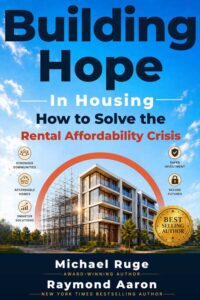
Michael Ruge takes that problem seriously in Building Hope in Housing. Drawing on 45 years of experience building housing, Ruge argues that the current shortage did not appear overnight and will not disappear through a single policy change or one massive construction programme. His view is more practical: we need to understand what is preventing housing from being built and then remove enough of those obstacles to get projects moving.
The Housing Crisis Starts With Supply
Canada is short millions of homes. The chapter cites estimates putting the shortage somewhere between 3.5 million and 5.5 million units. The United States faces its own major shortage, including millions of affordable rental homes.
Basic supply and demand helps explain what happens next. When there are too few homes for the number of people who need them, prices rise. Renters feel it through higher monthly costs, while prospective buyers watch ownership move further out of reach.
The obvious question is: if demand is so strong, why aren’t developers simply building more?
According to Michael Ruge, that is where the Housing Crisis becomes more complicated.
Building a home involves much more than land, materials and labour. Developers also have to navigate permits, approvals, development charges, planning requirements and lengthy municipal processes. The chapter argues that these costs and delays can represent a substantial share of the overall development cost.
Ruge recalls a time when projects could be approved in weeks. Today, some can take years.
Those delays eventually affect the person buying or renting the finished home.
Housing Affects More Than Housing
 Southern Vancouver Island provides one of the chapter’s clearest examples of how a shortage can ripple through a community.
Ruge describes extremely tight rental conditions in the region, where people who would ordinarily rent mid-range accommodation move into less expensive units because they cannot find anything else. That puts additional pressure on lower-cost housing and the people who depend on it.
The effects do not stop with renters.
One local fast-food business, according to Ruge, was prepared to hire more employees but faced a basic problem: those workers needed somewhere to live. The business was reportedly ready to take 25 housing units immediately.
That’s an important side of the Housing Crisis that can get overlooked. Housing is economic infrastructure.
A community can attract employers, expand businesses and create jobs, but people still need somewhere reasonably close and affordable to live.
Michael Ruge Believes the Housing Crisis Is Solvable
One of the most optimistic messages in Ruge’s approach is also one of the simplest: no single developer needs to solve the entire problem.
He believes thousands of developers, ranging from smaller operators to larger builders, can contribute by creating projects of different sizes. A development adding five homes matters. So does one adding 50, 200 or 500.
That changes the conversation.
Instead of waiting for one enormous solution, communities can encourage many workable projects.
Ruge also argues that developers should pay close attention to where municipalities and governments already want housing built. Rather than spending years fighting to rezone unsuitable land, his strategy is to look for properties where future density is already encouraged.
It’s the real estate version of going where the puck is going.
Finding Practical Ways to Add Homes
The chapter includes several examples of this philosophy in action.
One project converted an unsuccessful office building into 35 long-term residential units. Space that was no longer working commercially became homes for people who wanted to live downtown.
Another project described by Ruge involves 170 suites using a long-term rent-to-own model. The planned studio units start at $200,000, compared with substantially higher average condo prices cited for the island.
The goal is to give renters a realistic route towards ownership rather than asking them to make an enormous financial jump in only a few years.
These examples won’t solve Canada’s Housing Crisis on their own. Ruge doesn’t suggest they will.
The bigger point is that housing shortages can be tackled project by project.
From Housing Crisis to Housing Opportunity
There is no quick fix for a shortage measured in millions of homes.
But there is a big difference between saying a problem is difficult and deciding it cannot be solved.
Michael Ruge’s experience has taught him to believe the first, not the second.
More housing requires developers, capital, sensible planning, workable financing and communities willing to accommodate growth. It also requires people who can look at an empty lot, an ageing property or an underused building and see what it could become.
The Housing Crisis was created over many years. Solving it will take time too.
But every new home is one more home that wasn’t there before.
And that is a pretty practical place to start.
Michael Ruge’s new book “Building Hope in the Housing – How to Solve the Rental Affordability Crisis” will be realeased this fall (2026).
Sources:
NLIHC Releases The Gap 2025: A Shortage of Affordable Homes
Quarterly Residential Vacancies and Homeownership, Second Quarter 2026
Housing Supply: Still Undersupplied by Millions of Units
Building Hope in Housing – How to Solve the Rental Affordability Crisis
Links to Michael Ruge, Affordable Apartments and his Initiatives:
A Fresh Take on Canada’s Housing Crisis
Homes as Assets: When Did That Happen?
Michael Ruge: It Takes a Village: The Beauty of Co-Housing Communities
Empty Offices, Full Homes – Michael Ruge’s Conversion Revolution